Mumias Sugar Company managers woke up one day and decided to divest from sports. They disbanded one of the best performing football clubs which at the time appeared to be financially stable. Tens of jobs were lost.
The disbandment of Mumias Sugar FC is not an isolated case. In the past 30 years alone, you can identify more than twenty defunct or struggling corporate teams that had become household names.
They include Eldoret KCC, Nakumatt FC, Utalii FC, Webuye Panpaper, Mafuco Bombers, Rivatex, Chemelil Sugar, SoNy Sugar and Reli. Strugglers include Shabana and Oserian Fastac.
The problem is not limited to football. For instance, we no longer have Telkom hockey club, and just the other day Homeboyz Rugby ‘divested to grassroot sport development’.
Since it keeps happening, we may wake up one day to the bad news that managers at KCB FC and KCB Rugby Club, Tusker, Bidco United, and Nzoia Sugar, among others no longer deem owning a club a wise business decision.
Livelihoods will be lost. Our sports industry will be hard hit. And we will continue to wallow in the vicious cycle of unsustainability and unpredictability.
A closer look at the topflight FKF Premier League shows five types of club management. Some are run by government agencies/departments, for instance Ulinzi Stars. The second type is run by for profit companies, for example Tusker. The third type where City Stars belongs is run by NGOs. The fourth kind of ownership is by business people, for example Kakamega Homeboyz. And lastly, we have the community clubs such as AFC Leopards.
Out of these five categories, clubs owned by corporates rarely survive in times of financial turmoil.
Those owned by communities may lack sponsorship, but most survive albeit at the cost of frequent relegations.
The clubs owned by businesspeople (currently Kariobangi Sharks, Wazito, Kakamega Homeboyz) are yet to show signs of the worst that could happen. Recently, Wazito FC ownership changed after Dubai-based businessman Ricardo Badoer sold it to Kisumu tycoon Engineer Joel Odongo.
Meanwhile, even though some clubs under government agencies have run into trouble in the past (think of Utalii, Reli, MoTCom or MoW), many still exist.
However, some are replicates from same departments. For instance, why would we have Nairobi Stima, Western Stima, Coast Stima, etc? Why not have a stronger community team in the top flight being sponsored by Kenya Power?
There is a sustainable way forward out of this mesh of unpredictability if Kenya wants to become a sporting powerhouse and create jobs for our youth. Examine the following scenarios.
When Mumias Sugar FC folded up, the parent company at one point became the main sponsor for AFC Leopards. Since then, Ingwe has changed sponsors numerous times. The club still exists despite Mumias Sugar Company facing challenges as a business.
If Utalii were the main sponsor of a community club, that club would most likely still exist – only that it would have a different sponsor. Sometimes when there is no sponsor, fans come to the rescue of community clubs through harambees, buying merchandise, and mobilizing for matches.
Other clubs without the advantage of bigger fanbases in the league of AFC Leopards and Gor Mahia still benefit from such mobilizations as away fans throng stadiums. In this case, the gate collections of K’Ogalo or Ingwe away matches largely go to the home team.
It thus makes sense that East African Breweries, for instance, sponsors a community club rather than own a team whose existence depends on the business decisions of the moment.
What would happen to Tusker FC should EABL decide to divest from sports, for a season or for good?
The tragedy of Italian giants Parma FC in 2003 still rings fresh in our ears. Its parent company collapsed when the club had experienced its most successful decade ever.
They had finished runners up in the Serie-A, won the Coppa Italia thrice, a Supercoppa Italiana, UEFA Cup twice, UEFA Cup Winners Cup once, and the European Super Cup once. But when the parent company collapsed, so did the club.
Parma has since reinvented itself but using a more resilient approach. Sponsoring instead of owning also gives corporates the freedom to advertise to varying audiences.
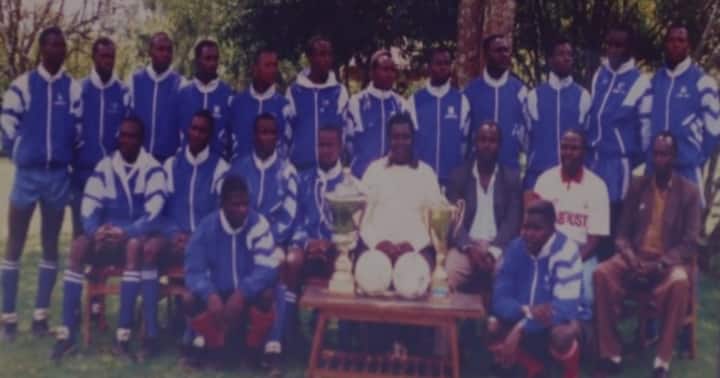
Feature photo: Defunct Eldoret KCC in its heydays.
By HILLARY NAMUNYU
-The writer is a Sports Development for Peace Advocate
 Wasomi